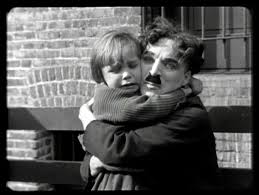
On Literary Pain: Comic and Tragic (From John Updike and Franz Kafka to Louis CK)

images

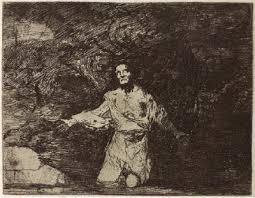
The feeling of pain (what Emmanuel Levinas calls the “little death”) and the existential onset of death are the most private experiences. It goes without saying that nobody can feel my pain or experience my death for me. Even though someone can take notice of pain and say, “I feel you.” He or she really can’t.   My pain – and not just my freedom – is what makes me a separate individual. It can be argued that pain gives one a sense of selfhood.   What narrative – as opposed to myth – can do is make the reader aware of pain and that all pain is not necessary.   The innocent suffer.  It can give us a view into the character’s private pain and contrast it to a public which cannot or refuses to see it. A thinker named Rene Girard argues that this perspective is what distinguishes monotheism from paganism.

It is plausible to argue that this perspective on pain is a key ingredient of modern literature. The more we can see the literary pain of a fictional character in contrast to his surroundings or people, the more valuable a piece of literature can be for us. It can help us to understand the relationship of pain to selfhood and the world. However, there is another side to this coin. This perspective is tragic, not comic. Comedy isn’t interested in pain so much as in what Freud would call the release of tension (for Freud the psyche feels pleasure when it releases such tension).   In modern literature, we also experience such a release from pain. It may not be complete, but its release does make things better.  It may not be as deep but it means a lot to us.  When we laugh at ourselves, we can live better.  (To put it simply: pain is heavy; comedy is light.)

John Updike is an interesting Pulitzer Prize winning writer. He tends more toward a fiction that is about pain and sharing that pain as a kind of secret with his audience. I find his theology of pain interesting. His obsession with pain is affected by his belief that suffering has a religious quality (perhaps in a sense similar to Kierkegaard).  In his novel, The Centaur, he takes a Kafkaesque premise (of a human turning into a creature) but instead of having the character turn into a bug he has the main character turn into a centaur.   And instead of having this happen in the privacy of the home and within the space of the family, Updike has it happen in the midst of the public sphere (in front of a class).   The subject is – immediately – a kind of Christ figure who is publically ridiculed when he “turns.”

Caldwell turned and as he turned his ankle received an arrow. The class burst into laughter. The pain scaled the slender core of his shin, whirled in the complexities of his knee, and swollen broader, more thunderous, mounted into his bowels. (9)

Updike moves back and forth between his private pain and his public ridicule (laughter, here, is not comic; it is a cruel kind of laughter – what the poet, Charles Baudelaire, would call Satanic laughter):

The laughter of the class, graduating from the first shrill bark of surprise into a deliberately aimed hooting, seemed to crowd against him, to crush the privacy that he so much desired, a privacy in which he could be alone with his pain, gauging its strength, estimating its duration, inspecting its anatomy. (9)

The contrast is explicit.   Updike’s narrator is telling his reader about how significant private pain is and how the inability to feel one’s own pain – as a result of humiliation – marks the “crush(ing)” of selfhood.

Updike’s close descriptions of the pain suggest that it is not merely a private affair. Its description takes on a kind of religious aura:

The pain seemed to be displacing with its own hairy segments his heart and lungs; as its gripped swelled in his throat he felt he was holding his brain like a morsel on a platter high out of hungry reach. (9)

The following sentences note how Caldwell is overwhelmed by external sensory stimuli. He leaves the classroom to flee it and only comes across more noise as he passes through the hall of the public school.

The narrator suggests that his pain helps Caldwell to grow and mature. He now feels – since he is a Centaur – a split between his lower and upper parts of his body:

His top half felt all afloat in the starry firmament of ideals and young voices singing; the rest of his self was heavily sunk in a swamp where it must, inevitably, drown. (10)

His top and bottom suggest a mind/body dualism. But it is his body and its pain that make him aware of his selfhood.   But Updike suggests something interesting about the relationship of pain to the world. While the boys in school ridicule him and force him into himself, the space of nature does the opposite:

Outdoors, in the face of spatial grandeur, his pain seemed abashed. Dwarfed, it retreated into his ankle, became hard and sullen and contemptible.. Caldwell’s strange silhouette took on dignity; his shoulders – a little narrow for so large a creature – straightened, and he moved, if not at a prance, yet with such a pressured stoic grace that the limp was enrolled in his stride. (11)

From here, Updike has him turn toward his home (which, as we can see here, he approaches with a kind of strength). The contrast with Kafka’s bug is suggestive. Updike seems to be exploring a different kind of selfhood. While the Centaur’s pain is shared with you, the reader; we also see that he has a unique relationship with nature. Kafka’s bug has no such relationship. He is confined to a house and lives, suffers, and dies in a house (or to be more specific, in his bedroom).   Kafka’s story, it seems, is more tragic. The fate of the soul – apparently, for Kafka – is to suffer privately and to be discarded by his family and the world.

While Kafka’s Gregor Samsa “turns” into a bug sometime while he is asleep, Updike’s Caldwell turns in front of the class. His shame is more public.   But he can leave them. He can live his solitude in the world.   There is nothing comical about either Updike or Kafka’s creatures.   They are tragic.

Is this the secret of literature? Do we need to deepen our sense of pain? Is Updike associating comedy and laughter with ridicule and crushing the soul? Is that fair? Can’t comedy also be associated with selfhood? How does comedy – in literature – create another kind of solidarity? Doesn’t that solidarity also include aspects of the body and pain –albeit a kind of relief from pain?

Or is it the case that comedy – like that of Louis CK – reminds us that pain is something that we can and perhaps should laugh at because…it won’t just go away? With age, it only increases.   And a good deed, as we see in this clip, can always devolve into a bad one. However, this devolution may also give us something to laugh about since we all know what’s it’s like to screw up. Perhaps it’s the event that sticks out in comedy and the private anguish of this or that character.   Louis CK brings both into play and brings it all to the surface.


What Am I Next? Tsimsum, Soul & Traversing Space in Michel Serres’ “The Troubadour of Knowledge”

Unknown

Language can take us places. It can create an opportunity for us to leave ourselves and go somewhere we have never been. But the only way for that kind of displacement to happen is for us to identify with the text and its movements. However, not all texts will do.   A good writer has an acute sense of movement and change. This sensibility is reflected in a kind of writing that not only moves us but also gives us a kind of knowing that Shunryu Suzuki – the famous Zen master – associates with readiness (“It is the readiness of the mind that is wisdom”).     For each line to be moving, one must be ready for what Michel Serres calls “exposure” or what Jean Luc Nancy would call surprise. In Serres’ The Troubadour of Knowledge, exposure marks a sudden movement from contraction to expansion. I would aver that this articulation of movement is a figuration for the dynamic process of tsimtsum.   By articulating exposure, contraction, and expansion, Serres takes the reader through what I would call a “theology of smallness.”

In The Troubadour of Knowledge, Serres tells his reader to get ready:

Be on the alert! Watch out! A given event, this mood, a project or thought passes, requires, solicits: in this way a gap arises. (28)

The gap that occurs resonates with the notion of tsimtsum because it suggests a withdrawal and an opening that occurs between God and man.

Precisely the divergence of walking: the child goes to seek its fortune in the world, launches one foot in relation to the other foot that is set down, rooted, a root directed toward the center of the Earth even though it covers a locality. The disequilibrium free of cares, with no guarantees, with an inchoate disquiet, laughing and risky, being has just dumped the there. It is exposed. It abandons abasement and rises up. Grows and launches its branch. Jumps. It leaves what is stable and moves way. Walks, runs. It leaves the shore and takes off. Swims. It abandons habit to experiment. It evolves. Offers. Loves. Passes the ball.   Forgets its own home, climbs, travels, wanders, gets to know, looks, invents, thinks. (28)

For Serres, the “there” is the “position” of being (it is a contracted point) and there is a distance or “gap” between this position and what he calls “exposure.”   This third thing – this gap between position and exposure – invents a place that is exposed. It is not my place but the space of otherness, expansion, and life. Through this exposure, I am no longer the same being occupying the same position:

Who am I? First this stable position that cannot be uprooted. Tree or vegetable, some kind of green. What am I next? I am no longer there, I am not me, I expose myself: I am that exposure. I am toward the other step, no longer in rootedness, but at the extremities, made mobile by the wind, at the branchings, on the summit of the mountain, at the other end of the world from which I depart, in animal movements, crawling, flight, running….(30)

What, Serres asks, am I “as a whole?” He answers that I am the “totality of the volume between being-there and the exposed point, between the position set down in this place, a thesis that is often low, and exposure”(30). He calls the distance between the “low” position and exposure – which is a part of a whole or totality and he calls the “large dimension” – the soul.

The two points between position and exposure can also be understood in terms of contraction and expansion: “the low and stable point of the place or the there positioned, set down, on the one hand, and the high point, the nonplace or enlargement of the soul, the risk or liberation, explosion”(30).

An interesting counterpoint to Serres can be found in Jean Luc Nancy who sees presence – qua laughter – as an explosion of presence but fails to note that this explosion returns to a point of contraction.   Serres likens the contraction to humility and earth and the expansion to God: “God magnifies my soul; my soul magnifies God; the separation between nothing and everything – magnitude makes God and my soul”(31).

A telling thing about Serres’ reading is that in writing this way, he like Nancy, seems to only focus on the movement toward expansion and God. God, it seems, is not to be found in the contraction. Rather, for Serres, position, earth, and death seem to be synonymous. While he is right to note the space between position and exposure, he is averse to maintaining the tension. Perhaps this is because he wants to measure the “space” between one and the other so as to experience joy.

The humblest experience of joy confirms that the soul fills the glory of the skies with its song or the world with its nothingness. And the same for time: beatitude runs from generation to generation, so that the devout inhabits the unfurled omnitude of space and history.  

Accompanied by joy, experience opens this space – which goes from there to elsewhere and can go from Earth to God – for the construction or dilation of the soul, by opening up or piercing a passage, a threshold, a door, a port through which to reach one of these exposed places.   (31)

Experience “traverses these spaces.” But it comes to end in ecstasy and “creates a differential in time”(31).   Experience is – by its very nature – expansive. It goes beyond the “bestial instinct” which is “positioned” and is a “being there.”   While Serres sees the human in terms of experiences venture away from the position, his reading of humility puts it closer to death and locality.

This reading is fascinating insofar as Rabbi Joseph Soloveichik in his Lonely Man of Faith argues that there are “two Adams” – one that contracts and one that expands. Serres, it seems is more into the second Adam which, according to Soloveichik, is a figure for humanities desire to experience, know, and move more. The second Adam experiences joy but also frustration at limitations while the first Adam is local, closer to death and humility. Judaism – for Soloveichik – exists between these poles. One balances out the other and the tsimtsum creates this tension. Serres doesn’t see God in the contraction so much as in the expansion.

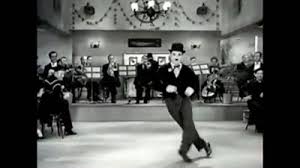
The schlemiel character exists between the two. The schlemiel is a small character. But while he is small in the realm of experience, he is large in the realm of goodness. The soul of the schlemiel is measured by his distance from the second Adam. Nonetheless, Sholem Aleichem’s schlemiels (Motl and Menachem Mendl) both set out for America and I.B. Singer’s Gimpel is on the move. They aren’t looking for more knowledge and experience, however. They are looking for goodness and trust. They are exposed to all types of accidents and lies but they keep on the move.   Much like Charlie Chaplin who doesn’t seem to stop moving, the schlemiel’s experience of God, so to speak, is in his narrow escape from this or that fate (on this note, Hannah Arendt calls the Chaplanesque schlemiel “the suspect”). His joy is on the run and, playing on Serres, I’d argue that it measures the space between position and exposure. His life is one non-stop tsimtsum, a theology of smallness.

When I look at Chaplin or when I read Aleichem’s Motl’s, I can’t help but hear Serres in my ear….with a comical twist:

What am I next? I am no longer there, I am not me, I expose myself: I am that exposure. I am toward the other step, no longer in rootedness, but at the extremities, made mobile by the wind, at the branchings, on the summit of the mountain, at the other end of the world from which I depart, in animal movements, crawling, flight, running


Sleeplessness, Insomnia, and Ambien: On Jonathan Crary’s “24/7”

Unknown-1

Unlike ever before, the possibility that we are living in a culture that never sleeps is becoming a reality.   Whether it’s the constant need (or is it demand?) to check one’s email, post on Facebook, or go through Twitter feeds, none of us can escape being implicated in what the art historian and critical theorist Jonathan Crary would call 24/7.   His book, 24/7: Late Capitalism and the Ends of Sleep offers a very pessimistic prognosis of the reality we are in and argues that the only way to battle it is, strangely enough, through sleep. No form of “awakening” or resistance can dislodge or disrupt 24/7.   All forms of resistance that we have turned to in the past are ineffective against it: art, literature, protests, violence, etc.   And this includes the theoretical possibilities of resistance posed by such great thinkers as Emmanuel Levinas, Jacques Derrida, and Hannah Arendt.

Crary argues that “24/7 steadily undermines distinctions between day and night, between light and dark, and between action and repose”(17). Like Walter Benjamin and Giorgio Agamben, he thinks that “experience” is no longer possible. But he has a different explanation as to why this is the case. It is 24/7 which is the culprit not speed or technology.   It is a “zone of insensibility, of amnesia.”   Crary draws on Maurice Blanchot’s book, The Writing of the Disaster, to explain:

It (24/7) is both of and after the disaster, characterized by the empty sky, in which no star or sign is visible, in which one’s bearings are lost and orientation is impossible.   More concretely, it is like a state of emergency, when a bank of floodlights are suddenly switched on in the middle of the night, seemingly as a response to some extreme circumstances, but which never get turned off and become domesticated into a permanent condition. (17)

The planet, says Crary, becomes a “non-stop work site or an always open shopping mall with infinite choices, tasks, selections, and digressions.” There is nowhere we can stop and think or have repose.     All of this is “hastening the exhaustion of life and the depletion of resources.”

The only “natural barrier” against the “full realization of 24/7 capitalism” is sleep. Nonetheless, it can be “wrecked.”   To explain, Crary points out how – as of a study in 2010 – around 50 million people in the USA are taking Ambien or Lunesta.   Today, that figure is likely much higher.   It would be a mistake, argues Crary, to think that they would totally eliminate insomnia: “insomnia is now inseperable from many other forms of dispossession and social ruin occurring globally”(18).   In other words, the mass experience of insomnia in the USA is “continuous with a generalized condition of worldlessness” and it isn’t going to get any better (regardless of how good the sleeping pills are).   24/7 is a global phenomenon and no first world country is exempt.

Citing Emmanuel Levinas’s reading of insomnia in terms of ethics – as a state of ethical vigilance in the face of “catastrophes of our era” – Crary argues that one form of insomnia may overtake another:

Insomnia corresponds to the necessity of vigilance, to a refusal to overlook the horror and injustice that pervades the world.   It is the disquiet of the effort to avoid inattention to the torment of the other.   But its disquiet is also the frustrating inefficacy of an ethic of watchfulness; the act of witnessing and its monotony can become a mere enduring of the night, the disaster….For Levinas, insomnia always hovers between self-absorption and a radical depersonalization; it does not exclude a concern for the other, but it provides no clear sense of a space for the other’s presence. It is where we face the near impossibility of living humanely. (19)

Playing on Jacques Derrida’s notion of the specter and Walter Benjamin’s mediations on the return of the (historically) repressed, Crary argues that the 24/7 world eradicates “shadows and obscurity and alternate temporalities”(19).   It is a “world identical to itself, a world with the shallowest of pasts, and thus in principle without specters”(19). Moreover, it seems to eliminate the wellsprings of both philosophy and religion (as per Aristotle, Heidegger, and AJ Heschel): wonder. 24/7 puts forth a “fraudulent brightness that presumes to extend everywhere and to preempt any mystery or unknowablility”(19). In the space of 24/7 nothing can truly come to light – no mystery, no awakening, no self-discovery that comes out of the darkness. Crary argues that 24/7 can “neutralize or absorb many dislocating experiences of return (or the past, specters) that could potentially undermine the substantiality and identity of the present and its apparent self-sufficiency”(20).

Although Hannah Arendt’s work is celebrated by Judith Butler and many others as offering a possibility for radical change and a “political life”(bios politicos). Crary disagrees. Drawing on her work that distinguishes the private from the public realm, he argues that for this distinction to work there needs to be a clear distinction (as she notes) between light and dark:

Over many years, she used figures of light and visibility in her accounts of what was necessary for there to be any substantive political life. For an individual to have political effectiveness, there needed to be balance, a movement between the bright, even harsh exposure of public activity and the protected, shielded sphere of domestic or private life, of what she calls the “darkness of sheltered existence. (21)

But without the space or time for privacy (away from what Arendt calls the “implacable bright light of constant presence of others on the public scene”), avers Crary, there “could be no possibility of the nurturing of the singularity of the self”(21).   Crary, echoing Arednt, says that only this kind of self could make a contribution to the public good. But…what happens when that kind of self is no longer possible because of….24/7?

The rhetoric of political or spiritual awakenings whether through Paul, Jewish mysticism, or the Communists, so as to recover some kind of sleeping authenticity, has no effect in 24/7. Playing on Carl Schmidt, Walter Benjamin, and Giorgio Agamben, Crary argues that “awakening” as a “form of decisionism” in which “the experience of a redemptive moment that seems to disrupt historical time, in which an individual undergoes a self-transforming encounter with a previously unknown future” is “incongruous” with the “global system that never sleeps”(24).

The only thing left, argues Crary, is (to) sleep:

The larger thrust of my argument is that, in the context of our own present, sleep can stand for the durability of the social, and the sleep might be analogous to other thresholds could defend or protect itself. As the most private, most vulnerable state common to all, sleep is crucially dependent on society in order to be sustained. (25)

The obvious question is how sleep can change the world. This proposal doesn’t make any sense and, given the excitement over the word “revolution” in the present American political campaign, it seems counterintuitive. But, as Crary would argue, any claim to changing the system would still be under the domination of 24/7. For Crary, sleeplessness makes all these activities seem trivial and even nostalgic.

Regardless of what you think, all you of have to do is take note of how many times you felt the urgent need to check Facebook, update a status, or Tweet something in order to seem relevant and alive (while at same time feeling exhausted and depleted) to know that 24/7 is not simply a concept…it’s a reality.   The question we need to ask is whether – as James Joyce wrote in his epic novel Ulysses, we can “awake” from “the nightmare of history.” Or will we just have to accept it? Will literature, art, or poetry no longer provide us with shelter from the storm?

What are the implications of 24/7? If the metaphor of awaking and starting something new and authentic is foreclosed by 24/7, perhaps the only metaphor left is sleep. If all the ghosts of history are, so to speak, busted by the endless light of 24/7, what is left to shake history? Can we be vigilant anymore when insomnia is endemic and violence is constantly reabsorbed into the media? Can we nurture our singularity in the darkness of our private spaces when there the private space has been effaced by 24/7? Can we hope for a spiritual or political awakening when we are always awake?

As you can see, I have many questions for Crary.   All of these questions must address his pessimistic claim that all previous models of resistance seem to have been foreclosed by 24/7. Is he correct? I think it is imperative that we answer this question. Otherwise, most of us who posit this or that thing as a form of resistance are willing to ignore the elephant in the room.  As we upload our next status update…like everyone else…we should try to pause and take notice of how restless we have become.   It seems as if you or I don’t have much time to keep up. But if you or I don’t, we have nothing to worry about.   Simply abstain from taking your Ambien and you’ll have time..you just won’t have sleep.

A Theology of Smallness? A Wild Take on the Schlemiel’s Smallness & Tsimsum

images-2

Recently, I have been engaged in a fascinating conversation with a colleague about the concept of tsimtsum.   After suggesting that I think about the tsimtsum in terms of contraction and expansion, he asked me a personal question. Would I, at this very moment, prefer expanding or contracting? After thinking about it, it struck me that he was aligning the schlemiel with only one of these possibilities: contraction.   A person who does not want to expand is a schlemiel. For this reason, it seems illogical that a person who, by a certain definition, desires to live and expand, would want to contract.   He told me that what a person desires most, according to this way of thinking, is to expand, be free, and be joyful.

I am astonished at the implications of what he was saying. Yes, I desired those things. If I do, does that mean that I am not a schlemiel? Does the schlemiel, if it is identified with contraction, suggest the opposite? Does the schlemiel desire to be small, limited, and sad? If this is a choice, than wouldn’t deciding to be a schlemiel be equated with self-sabotage?

Intuitively, no, I can’t believe it. It can’t be true. A schlemiel doesn’t always sabotage himself. There are times when a schlemiel actually gets lucky and stumbles over things….and then into things that take him or her to another level. Perhaps becoming a schlemiel is a different choice or…no choice at all.

To riff on Jacques Derrida, if we are always already small, than what choice do we have but to find joy instead of sadness in smallness?     And why can’t contraction also be expansion? Why do they have opposite value? Perhaps in becoming small one grows.   The experience of smallness gives the schlemiel a certain kind of vitality which is born out of the relationship to the other. I am very interested in how one can see this not only in secular texts but also in Hasidic texts, which have a religious intent.

In researching what I call a “theology of smallness,” I have sought for a literary figuration of smallness by a Hasidic rabbi. For in doing that, I am researching what I call a religious schlemiel.     According to Ruth Wisse, the religious schlemiel can be found in Rabbi Nachman of Breslav’s tale, “The Tam (Simpleton) and the Chakham (Sophisticate).” She argues the Rabbi Nachman of Breslav’s 19th century version of the schlemiel is a prototype for the early Yiddish writers of the late 19th century who drew on it constantly.

What I find most interesting about the tale is that the main character, a Tam (for now on, Simpleton), is already small and remains so throughout the tale. His smallness inheres, fundamentally, in his difference from his old time friend, the Chakham (sophisticate).

The schlemiel-slash-simpleton’s smallness inheres in the fact that he stays in the same town – while the Chakham goes abroad – he works on one craft all his life, cobbling – while the Chakham learns many trades – and he looks at people in a simple, kind way and trusts humanity – while the Chakham does not. His smallness is also, therefore, intellectual. What makes him unique is that, in his simplicity, in his lack of intellectual expansion, he is happy – while the Chakham is angry and bitter because he sees the world as foolish and gullible.

It is the simpleton who, by no work of his own, is somehow discovered by the King.   But so is the Chakham (the fact that they are friends and are living together is actually astonishing for the king).   Two different messengers – matching the nature of the Simpelton and the Chakham While the simpleton takes the invitation and believes the messenger, the Chakham does not. He cannot believe that 1) he would be desired by the king and 2) there is a king. The narrative goes on to show that the simpleton meets the king and becomes the leader over a province – within which lives the Chakham.

One day the Chakham is brought to him – for judgment – because he created havoc over a “baal shem tov” (a healer). When the Chakham stumbles across the threshold and looks up to see the Simpleton, he is astonished. How could it be that you, a small man, should be come the big leader of a province? The answer is that the king gave him this position, but the Chakham refuses to believe this because, as he had always insisted, no one has ever experienced the king: the king is a myth. To play on Nietzsche, the God he and everyone serves is dead (he was never alive).

The irony is the Chakham becomes small (out of self-sabotage, if you will) while the Simpleton happens to become “big.” However, the Simpleton’s bigness hasn’t changed his smallness. What makes him small is the fact that he is not only close to the king, but is also not far away from his own people. We can identify with the schlemiel.

Rabbi Nachman’s religious schlemiel is, as Hannah Arendt said of the schlemiel in “The Jew as Pariah,” a “man of the people.”   The people love and desire the schlemiel because he doesn’t become distant from people when he becomes their leader. This gives birth to another political question: how could it be that a schlemiel could be a leader? This is absurd.

However, this is what we see Charlie Chaplin doing at the end of his film, The Great Dictator. His bigness (expansion, literally, playing with the globe) is really small because he appeals to our natural sense of right and wrong through humor. But what Chaplin did was to secularize this kind of smallness and to show that if we are to expand, we must contract.

But in the desire to watch Chaplin’s smallness as he stumbles from one thing to another, perhaps one can say that we expand. Since Chaplin falls with grace, he redeems smallness from the jaws of tragedy. And this gives birth to hope.

This is how I would answer if anyone asked me whether I desire contraction or expansion. What I – like millions of people – desire is a kind of contraction that creates a larger life and freedom.   That’s the irony of the religious schlemiel.   If it is seen as stumbling and small, since his falling is done with a certain kind of grace and freedom, Chaplin’s performance shows the schlemiel to be a character who may be chased down or on the run (Hannah Arendt calls Chaplin the “suspect”). But, ultimately, will likely get away by the tips of his shoes.

But when he stumbles into safety, he creates a new kind of life or hope in life’s growth and expansion.   The schlemiel can tell us that there will – somehow – be a better life. That trust is found not only in Rabbi Nachman’s tale but in Charlie Chaplin’s stumblings through film. Without the element of trust in somehow getting through, smallness would be a tragedy rather than a comedy. It would be equated with death, not life.

This leads to a few final questions that I need to think more about. In accepting a certain kind of contraction, perhaps I am really accepting another kind of expansion?   But if this certain kind of contraction is taken (in a Kiergegaardian sense) to be aesthetic and not ethical, I can understand that identification of the schlemiel has nothing to do with life or, rather, it sabotages it. If I identify with the schlemiel I identify with an aesthetic kind of smallness. Is this smallness ethical or aesthetic? Can it be both?   Is it, as Kierkegaard might say, religious?

Yes.  Here’s a wild possibility: perhaps the identification of the schlemiel can be ethical, aesthetic, and religious at the same time.

But it is only “yes” if this comedy leads to more life and more trust.   The expansion that comes with the identification with the schlemiel is ethical, aesthetic, and vital (in a physical and spiritual sense). It is, ultimately, a vindication of humanity and the possibly…of God.   This is the possibility that is posed by a theology of smallness.*    It is desirable.  However, as Gershom Scholem said about tsimtsum, the relation of the God to the world (like the relationship of the schlemiel to the audience) should be thought of in terms of a relation to a “living organism” with a “Janus Faced Character.” The desire for smallness, in this sense, may bring contraction or it may bring expansion. But…we can only hope for the best even though that may change, as the French poet Mallarme would say, with a “throw of the dice.” Perhaps, in this sense, faith is tied to chance.


* The possibility poses, for me, two final questions regarding the meaning of one’s desire for seeing both religious and secular schlemiels: 1) Does one decide on taking the schlemiel’s way of life by virtue of desiring it and is this choice real or virtual? And 2) What are the aesthetics and ethics of such a desire?


The Stranger, Uninvited: Maurice Blanchot on Tsimtsum, the Other & the “God of Isaac Luria”

images-1

Maurice Blanchot’s writing is difficult and often opaque, but at least it’s consistent.   We see this throughout his books. To read Blanchot, is to ask the right questions. The task of the reader is to figure out what the problems and paradoxes Blanchot is pondering are and to figure out what his approach to them suggests. Of the topics Blanchot writes about, one of the most interesting is the relationship of writing to what he calls “the disaster.”   In a surprising aside, Blanchot suggests that the view of God and His creation of the world, as proposed by the 16th century Kabbalist, Isaac Luria (the Ari), provide a model for understanding writing and art.   What is most fascinating about Blanchot’s reading is that the primary movement of Tsimtsum – the movement of withdrawal from the world – can be read as the condition for the possibility of art, creation, and writing.   However, unlike Blanchot, we need to ask whether his reading of withdrawal presupposes the total absence of God or the writer from the artwork or…something else, something smaller, something…other.

In the opening pages of The Writing of the Disaster, Blanchot tells us that the desire to write is “absurd” because “writing is the decay of the will, just as it is the loss of power, and the fall of the regular fall of the beat, the disaster again”(11).     The more one writes, the less one wills and the less power one has. In effect, the writer and his or her assumed power is ruined by writing.   Writing has a disasterous affect. It reduces the will but it doesn’t annihilate it.   It makes one small. Instead of expanding my world, it shrinks it.

On the other hand, Blanchot tells us that the attempt to not write, so that one can “write out of failure,” puts one in “fellowship with the disaster.” Blanchot suggests that the writer should stop seeing writing as a form of salvation or a means to success.   This, of course, goes against the grain of what most writers truly believe. It is counter-intuitive; but the presumption here is that acting “as if” it is true may (perhaps) yield something unexpected. Writing may…happen, but not because I have willed it to happen:

May words cease to be arms; means of action, means of salvation. Let us count, rather, on disarray….whether it happens or not; it is the writing of the disaster. (12)

After noting this, Blanchot contradicts what he said above regarding “writing out of failure” and says that we “should not entrust ourselves to failure. That would only be to indulge in the nostalgia for success.”

What should we do, then? How is it possible for a writer to write out of neither success nor failure? Blanchot suggests that we, rather, “seek out” that “which out-plays (the way the disaster de-scribes)….it is what by chance befalls, and I fall beneath it, having always fallen already”(12).   Failure – in other words – is something that happens outside of us: we don’t start from a position of failure; rather, we may or may not “fall beneath” chance and, when we do, we will discover that we have “always fallen already.”   It is not a choice. This is what he calls the “thought of disaster,” which “dismisses all ideas of failure and success.”   This “thought” produces what he calls a “separate silence,” a space where the “other, keeping still, announces himself”(13).

As a reader, one may – at this point – be rightfully confused. Blanchot wants us to imagine a world and a creative space in which the will and all desire for success or the experience of failure have nothing to do with “me.”   This, he claims, is the “thought of disaster.” But, in the wake of this thought, I realize that I am not alone; I can experience a “separate silence” which is not mine; it is the other’s silence. In this space, “the other, keeping still, announces himself.” What Blanchot is doing, by way of reducing the self, its power, and its expansiveness, is not only making room for the “announcement” of the other; it is also creating a kind of Creation myth.   This is evident in the next aphorism, where he evokes Isaac Luria and his creation myth, which Luria calls “tsimtsum.”

Withdrawal and not expansion. Such would be art, in the manner of the God of Isaac Luria, who creates by excluding himself. (13)

Writing on tsimsum, Gershom Scholem tells us that there are two phases: one of withdrawal and the other of birth.   Since they are so different, Scholem says that these two phases have a “Janus character.”   Although Blanchot only focuses on withdrawal, he indirectly suggests that by withdrawing ourselves from what we do (by becoming small), we, like God, create. But , in truth,this creation is more or less a disclosure (or discovery) of the other. What Blanchot leaves unsaid in this aphorism is what he mentioned in the aphorism before; namely, that the withdrawal makes room for the announcement of the other. The other is, so to speak, born (announced) out of that withdrawal.

Scholem also points out that, since the Ari is a “theistic mystic” (rather than a pantheistic mystic), things are left separate (“with a reality of their own” so as not to dissolve in the Panthesitic “All”). This does not mean, however, that they are in total separation and Exile since there is what Scholem calls – following the Ari – the reshimu (the trace of God). Scholem argues that there is a dynamism between God and Creation (“steaming back” and flowing “outward”). For this reason, he likens God to a “living organism” who approaches and withdraws.  This means that withdrawal (or the “disaster,” as Blanchot would say) is not total.

Building on Blanchot, I would add that in withdrawing from Creation there is also the possibility of the other’s approach. We fall under the sway of chance, but this has to do with the blinkering (or as Michael Wyschogrod would say, “dark”) relation between man and God. What Blanchot calls the “thought of the disaster” is not a total disaster (man is not annihilated). Rather, disaster is a making small. God’s withdrawal and approach work on the micro not the macro level.

This relation is beyond success and failure because it only, in part, has to do with me. It also involves the other. Moreover, the approach and withdrawal – qua tsimtsum – are (as Scholem notes in his reading of he Ari) always happening. We may or may not merit disclosure or a hearing of the “announcement,” but we cannot merit anything if we are not made small by the “thought of disaster.” This thought opens one up to the possibility that, in the face of disaster, God hides his face. To be sure, this experience of concealment is a possibility of this thought. To think of total concealment as the necessity, however, would be a mistake (regarding what the Ari is suggesting). To think of a withdrawal without any possibility of revelation, is to take Blanchot to be articulating the truth of creation as total exile and withdrawal.   It would suggest that there is no dynamic or rhythm between God and man.

I would suggest, with a wink toward Martin Heidegger’s notion of “nihilation” (in his essay “What is Metaphysics?”) that while the world or the self may be nihilated and made strange, the self and the world are not annihilated by the nothing or the disaster. Both remain. But the self and the world are smaller than they were before it had this thought. Even so – in contrast to Heidegger and with a wink toward Emmanuel Levinas – I would argue (as Blanchot suggests) that in the wake of disaster the other “announces himself.”   In this creation myth, disaster – in making us small – is the condition for the possibility of a birth and the experience of the other.   The disaster comes and goes, as Blanchot suggests, like a rhythm just like the other comes and goes. The reason it does so – and reduces us and our world – has to do with the fact that we are always expanding and tend to forget how small we are not only in relation to the other but also in relation to God. We can only meet the other or God when we are small. But this smallness is not something we can simply decide on. Like the “thought of disaster,” it happens.

Blanchot – like the Ari – is asking us to envision a different kind of creation.   But instead of the “thought of disaster” being nihilistic, it is affirmative. By becoming small, writing (and creation) can make room for the other (creature) whose withdrawal and approach give meaning to my little – nihilated – and creaturely existence.

But this approach should not simply to be thought of in terms of what Blanchot suggests: sound and silence.   The other’s silence, as Paul Celan notes in one poem entitled “ABOVE SOUNDLESS,” is conveyed by presence. Celan figures the appearance of the other – out of nothing – in terms of a stranger coming in from the rain, on the threshold, with a tear in his eye. His time with us – like the numbers he counts – is limited. He comes and goes but he “betokens insight.” To appreciate this, one must become small and take the lines of the poem to be suggesting that “our” relation to the stranger makes “us” small and his stay (and our time with him) short.


The stranger, uninvited, from where,

The guest.

His dripping clothes.

His dripping eye.

 ….

His clothes-and-yes, like us

He is filled with night, he betokens

Insight, he counts now,

Like us, up to ten

And no farther.

The Janus Character of God and Existence: Gershom Scholem on the Implications of Tsimtsum

Unknown

One of the most interesting questions that the Kabbalah addresses deals with how one is to imagine God’s relationship to Creation.   The models that were sketched out to address this question have affected how Kabbalists have envisioned not just God but their experience of God in the world.   Is the relationship straightforward and simple or is it complex?

Writing on the Kabbalist Isaac Luria (the Ari), Gershom Scholem, in his Trends in Jewish Mysticism, tells us that, in comparison to the Zohar, “his cosmogony is both more original and more elaborate.”   Scholem finds the earlier, Neoplatonic conception of God’s relation to creation to be simple since it “begins with an act in which God projects His creative power out of His own self into space.”   And “every new act is a further stage in the process of externalization, which unfolds, in accordance with the emanationist doctrine of Neoplatonism, in a straight line downwards”(260).

In contrast to the Zohar’s emenationist perspective, Scholem says that Isaac Luria’s notion of Tsimtsum is complex.   Moreover, Scholem argues that it was “one of the most amazing and far reaching conceptions ever put forward in the whole history of Kabbalism.” Scholem, in the most economic language, explains that Tsimtsum “originally means ‘concentration’ or ‘contraction’ but if used in the Kabbalistic parlance it is best translated as ‘withdrawal’ or ‘retreat.’”(260).

Contrasting these two translations, Scholem takes note that while the Midrash explains that God “concentrates” himself into “one point” in one place (the Holy of Holies in the Temple), Tsimtsum suggests a “retreat away from the point.” To explain what this means and what it implies, Scholem first warns us that one should not simply think that this is the “withdrawal of God into his own Being in terms of Exile.”

Rather than do that, Scholem suggests that we think of Tsimtsum in terms of two “acts”:

The first act of all is not an act of revelation but one of limitation. Only in the second act does God send out a ray of His light and begin his revelation, or rather his unfolding as God the Creator, and the primordial space of His own creation. More than that, every new act of emanation and manifestation is preceded by one of concentration and retraction. (261)

Instead of being a simple process of emanation, this process is what Scholem calls a “double strain” since it includes light which “streams back into God and flows out of Him.”   This “perpetual tension” and “repeated effort” is the condition for the possibility of the world’s existence. Moshe Idel calls this “dynamism.”   It is the best attempt there is, says Scholem, to explain the Creation out of Nothing.   But it leads to a “theosophical mystery.”

For Scholem, the mystery emerges out of a tension between pantheism, which he associates with the emenation theory we find in the Zohar, and theism, which he associates with Tsimtsum.   While suggesting that there is a “residue” of “divine manifestation in every being,” Tsimtsum also suggests that “every being…acquires a reality of its own which guards it against the danger of dissolution into the non-individual being of the divine ‘all in all’”(262).  For this reason, Scholem calls the Ari a “theistic mystic.”

Scholem argues that from the period of European Renaissance onwards there was a clash between the Ari’s reading of Tsimtsum and those who clung to the pantheistic emanation theory we find in the Zohar.   Scholem’s brilliant move is to locate this tension in the interpretation of the Tsimtsum as literal or metaphorical.

If the Tsimtsum is interpreted metaphorically, than it is “only a veil which separate the individual consciousness from God in such a way as to give it the illusion of self-consciousness, in which it knows itself to be different from God”(262). In that case, “all it takes is an imperceptible change” so that “the heart may perceive the unity of divine subsistence in all that exists”(262). In other words, this “imperceptible change” will make room for the mystical experience that the Tsimtsum is an illusion and that all is God.

Scholem says in another essay (“The Messianic Idea in Judaism”) that, based on the literal reading of the Tsimtsum, we can understand how all things (in contrast to how the theory of emanation sees things) have “this basic Janus character – the limiting force and the emanating force, retreat and propagation. Only the concurrence of the two disparate motifs can produce being.”

The reading of God in terms of “limitation” changes how we see God and the world. Scholem, in this essay, calls this idea “paradoxical” and says it “has vitality” because “it expresses the notion of a living God – a God thought of as a living organism.”  What is so fascinating about Scholem’s claim is that, after making it, he doesn’t explain what it means that God is – in terms of Tsimtsum – a “living organism.” Rather, he discusses other ideas of the Ari (such as the “shattering of the vessels” or the notion of “tikkun”) which build on the notion of Tsimtsum. But in doing so, he refers to what he just explained – in terms of God as a “living organism”- as a “process.”

How does one merge the “Janus character” of God with a “living organism” and a “process”?   Is Scholem suggesting that a living organism – which retreats and propagates – is a process? And that this process is God?

What is fascinating about this reading is that Scholem differentiates it from emanationism and pantheism, which one can also call a process of God’s revealing himself. This process, however, is different because it is dynamic and includes a kind of blinkering that is uneven. God’s revelation – like that of an organism which propagates itself by giving birth to something new – is mixed with darkness and limitation. While the reading of tsimtsum in a figural manner is mystical, Scholem suggests – through this kind of approach – that the literal reading tends to not only be more theistic but also more biological.

Perhaps, in making such a reading, Scholem is moving along a trajectory mapped out by Michael Wyschogrod, which sees God in vital (yet not pantheistic) terms.   After all, the personal God that Wyschogrod takes to heart (like Martin Buber) is seen in terms of a God who comes and goes. As Wyschogrod notes in his book, The Body of Faith, God dwells and withdraws from the Jewish people. And like a living being, God loves and is vulnerable in this approach and withdrawal.

To bring this abstraction closer to earth, I’ll end with a fragment of a Paul Celan poem called “The Straightening.” It speaks to this coming and going – this dynamic tsimtsum of sorts – that has a “Janus character.” The poem dramatizes a play of light, darkness, and movement; advance and withdrawal, disclosure and concealment.   It suggests that God – in his relation to man and history – has a Janus Character and it calls for Him to “go to the eye” that is crying because of His concealment, perhaps during the Holocaust. (Note: Celan read Scholem’s Kabbalah scholarship and often brought Kabbalistic ideas into his poetry.)


Covered it

Up – who?


Came, came.

Came a word, came,

Came through the night,

Wanted to shine, wanted to shine.


Ash.

Ash, ash.

Night.

Night-and-night. – Go

To the eye, the moist one.


Go

To the eye,

The moist one –


Hasidic Roots, Secular Fruits: “Personal Mysticism” and the Political in a Networked Society

Ce0flBGUIAAm4wR

In today’s society, everything seems to be becoming more and more personal. In contrast to the not-so-distant past, less and less of what we do has to do with texts.   And if we read texts, they are in passing. Most of us don’t read novels or books of philosophy for wisdom or personal growth. To be sure, for most millennials it’s a chore. If any of us are “moved,” it is usually by what others say or feel either in person, on facebook or twitter, or through some media or other.   However, that movement needs to be defined: to be sure, it is often emotional or intellectual (at best), not spiritual. If we are moved – and that doesn’t happen too often – few of us see this or that person’s spiritual persona or charisma as inspiring us to change our lives.  Charisma is oftentimes mocked.    And those who are moved by this or that person are deemed…odd.

On Facebook this morning, I ran across this film clip which did its fair share of showing how being inspired or sharing it with others is ridiculous.   It suggests that people who are inspired are either stoned, dumb, or lost.

It’s interesting how, in difficult times, spirituality or religion has a large appeal. Today, despite the lack of great jobs, most of us feel self-important. Wit seems to be our guide through life, not spirituality. And, in truth, people don’t move us as much as an unexpected thing that they say or do. It’s the odd event that intrigues.

From this floating point above humanity, it’s easy for us to mock spirituality. Is there an alternative to this smug kind of nihilism? What is lost if it is deemed ridiculous to be inspired by other people? What happens if the only thing that moves us is the unexpected witty video clip, sound byte, or political intrigue, etc? One wonders if we can, once again, be inspired by other people to become more spiritual rather than fear that we are appearing more ridiculous.   Would that be backwards? Shouldn’t we be guided by wit and not by this or that person? Are we far away from what Moshe Idel – a Kabbalah scholar – calls “personal mysticism”?

In his Major Trends in Jewish Mysticism, Gershom Scholem argues that what makes Hasidism special “lies in the fact that mystics who had attained their spiritual aim – who, in Kabbalistic parlance, had discovered the secret of true Devekuth (clinging to G-d) – turned to people with their mystical knowledge, their “Kabbalism become Ethos,” and instead of cherishing as a mystery the most personal of all experiences, undertook to teach its secret to all men of good will”(342).   For Scholem, personal mysticism of the Hasidic variety isn’t “personal” (in the sense of only being mine); it is personal in the sense that it is shared. The secret is not hidden. It is open.

Sharing this secret – person to person – is what maters most. It is not the text of the Kabbalah that, as it did in the Medieval period, inspires the person to experience godliness. Now it is the person that is the carrier of mystery:

The believer no longer need the Kabbalah; he turned its mysteries into reality by fastening upon certain traits which the saint, or Zaddik, whose example he would follow, had placed in the center of his relation to God. Everyone, thus the doctrine ran, must try to become the embodiment of a certain ethical quality. Attributes like piety, service, love, devotion, humility, clemency, trust, even greatness and domination, because in this way enormously real and socially effective. (342)

Playing on Maimonides who saw Moses (in the Guide to the Perplexed) as the ideal person – because he could be intellectually connected to God while being with the people – Scholem argues that this double-ness takes on a mystical aspect with the righteous Hasid:

To live among ordinary men and yet to be alone with God, to speak profane language and yet to draw the strength to live from the source of existence, from the “upper root” of the soul – that is the paradox of which the mystical devotee is able to realize in his life and which makes him the center of the community of men. (343)

Scholem goes so far as to say that his personality displaces the doctrine of the Torah: “The whole development centers around the personality of the Hasidic saint; this is something entirely new. Personality takes the place of doctrine; what is lost in rationality by this change is gained in efficacy.”   The paradox is that he teaches his Hasidim that the love for the simpleton or common man is the “highest religious value.” The paradox is that the men whose “utterances not infrequently throw light on the paradoxical nature of mystical consciousness,” loved simplicity more than complexity. They were the “advocates of the simple and untainted belief in the common man, and this simplicity was even glorified by them as the highest religious value”(346).

In addition to “being” inspired, it was their celebration of the community and its simplicity that made the community experience the paradox in a personal manner. How could, as Larry David might say, a poor shmuck be so special? This realization is what inspired the masses that huddled around the Hasidic Tzadikim of the past to love being Jewish.   What fascinated Scholem most about all of this, however, was the enthusiasm around this personal mysticism.

The closest thing we have to this, today, can be found in the charisma of pop stars or major politicians.   But the fact of the matter is that this enthusiasm is found – as it was with the Hasidim – in the context of community.     In the video clip (above), the spirituality is unfocused because the people on stage are ridiculous. For this reason, the audience’s enthusiasm is also laughable.   If, however, the person on stage is special and is showing that he or she thinks you are special (although you’re really just a poor schmuck) that experience takes on a spiritual aura. And, today, this is what is odd because the communities that are inspired are mediated by culture not religion.   And – as we can see in politics – the devotees of this “personal mysticism” are less interested in doctrine and more interested in being liked by the exemplary leader who smiles at them and makes them feel special.   And – as with a Hasidic Rebbe – he helps them to dream; he makes everyone feel happy about being alive and in a living community that is infused with spirituality.

One person I think of, in this regard, is Bernie – or is it “Birdie”(?) – Sanders. He has had this kind of effect on people. The displacement, I would argue, is theological (in the Hasidic sense).   Echoing Scholem, we can say that his mysticism is his “ethos.” It seems to be displacing – at times – political doctrine.   He really “moves” people to think that they can take part in a radical change of the (American) world and a bifurcation of history.   There is, here, also an element of the messianic and what Scholem might call “messianic activism.” It may be secular but it feels spiritual.  Nonetheless, Larry David is always around the corner to “curb your enthusiasm.”

But enthusiasm can only be curbed…for so long.  While most people find spirituality and organized religion to be laughable, other people really want a Birdie Sanders sticker.   Get it while you can. Time is running out.  Isn’t this fun?

12899708_642981943734_1462168631_n

Is It True “You Can’t Reason Someone Out of a Belief They Didn’t Reason Themselves Into?”

Here is a wonderful, personal reflection and argument on faith, cognition, and process by Eric Linus Kaplan who, besides being a writer for Big Bang Theory, is a wonderful philosophical wrier. I love this post’s intimate comical/philosophical moments.

ericlinuskaplan's avatarEric Linus Kaplan

Sometimes I’ve found myself frustrated arguing with people about deep important beliefs.  I’ll come up with what I think is a good argument and they will remain unmoved.  For example I once forwarded to a scientologist the devastating New Yorker piece which showed that a major part of the founding belief of the Church of Scientology — that the founder, L.Ron Hubbard had been injured in a naval battle and cured himself through mind science — was based on a forgery.  His response was “Meh.”

It occurred to me that I was violating the old maxim — you can’t reason someone out of a belief that they didn’t reason themselves into.  People embrace big views — religions and political ones — for reasons having to do primarily with emotion, aesthetic response, and group identification.  If they embrace views like that you are not going to get them out of them…

View original post 519 more words

Jesus, President Obama & Bernie: The Messianic, American Politics, and a Sense of Humor

Unknown

Writing on the apostate Jewish Messiah, Sabbatai Zevi, Gershom Scholem argued that there are two kinds of messianic ideas: one is restorative and the other is apocalyptic. The latter idea is, for Scholem, the most dangerous because, in imagining the new world that will emerge when the messiah comes, it appeals to a sensibility that is desirous of miracles and things that are unimaginable.   It promises to, as Scholem puts it, destroy or radically alter the course of history.   In this sense,  it appeals to a sensibility that yearns for a violent conclusion to history, a revolutionary sensibility. Since it is so radical it will most likely, according to Scholem, lead to kind of nihilism. Scholem rightly points out that the Rabbis of the Talmud – and Moses Maimonides in particular – suppressed this idea because of its wild appeal to the imagination and its antinomian tendencies. Sabbatai Zevi and the Sabbateans who followed in his wake (and claimed to also be messiahs or harbingers of the messiah) provide him with evidence of how what he calls “messianic activism” is dangerous.   (The most extreme Sabbatian, Jacob Frank suggested that the messiah will come through sin. His disciples followed him into this abyss.)   What is the result of this disappointment?   Scholem argued that, for Judaism, the result was nihilism and lasting damage to what he calls the “substance of Judaism,” which is moral.

In the wake of messianic failure, things get worse, not better.   Reading his prognosis, one may wonder what Scholem would say about radical political movements which took on a messianic tone.   To be sure, he read them in a similar manner. Radicalism which takes on a utopian aura, for Scholem, can, as he says in one text, “tear open an abyss.”   But this can be read in two ways: in terms of whether they are successful or whether they are not. One need only think of the disappointments in the wake of Stalinism and Maoism (mass murder, suppression, the gulag, etc) to see this abyss in its historical reality.   On the other hand, if such messianic-slash-utopian dreams are not successful, the disappointment is more immediate and the frustrations one has with history, politics, and reality will only increase.

I bring the messianic idea up now because it has – since President Obama’s election – crept into and out of American politics. One need only think about how President Obama was likened to a savior by many people in 2008.   Many articles were written on this topic and people in the faith community wondered about the truth of these analogies and whether this “could be it.” To the minds of millions, he could save a lot of communities that were suffering and unite the country. Countless videos, websites, and chatrooms discussed this possibility with fervor and excited anticipation. But, as one can see today, many of these messianic expectations have not been fulfilled. And perhaps this has led – in some way – to the frustration many feel with the government and political system at this time.   Perhaps this has led to a kind of nihilism and has, as Scholem might say, torn open an abyss.

Most recently, utopian messianic yearnings – here and there – seem to be coming back with Bernie Sanders. Late in 2015, The Huffington Post put out a piece about how Jesus would vote and Bernie Sanders is featured as the closest to Jesus of early Christianity. And on February 17th 2016, USA Today featured an article by Stephen Prothero which wonders whether Jesus would vote for Bernie Sanders.   This query has led, in one widely circulated article, to another one (which is implicit in the first) as to how Bernie is like Jesus. In a Reddit thread from ten months ago, hundreds of comments emerged which addressed the possibility that Jesus was a socialist Jew like Bernie Sanders.

When a bird recently appeared on his podium in a rally in Portland, Oregon, people were enthralled and some have suggested that the bird was giving an omen. Although, in this meme, the messianism is displaced onto “mother nature,” it suggests that a choice has been made by a greater power. That Sanders is the one. Trump, in contrast, comes away as the anti-Christ figure (or a character that doesn’t fit into “mother nature’s plan”).  This is apparent in this image and has been suggested in a more than one place (in this or that article, twitter feed, etc).

birdie-sanders-vs-trump

While there is no full blown messianic movement behind Sanders, the fact of that matter is that there is an enthusiasm which could draw on the messianic idea. I wonder if this is inevitable since the utopian messianic idea is connected to the idea of revolution and radical change.   In hard times, there is a deep desire for radical change. And we are going through hard times now.   Scholem makes sure, in his reading of the Sabbateans, to point out that the condition for the possibility of the apocalyptic messianic idea is historical. The Jews that Sabbatai Zevi appealed to were in dire straights. They wanted radical historical change. The only problem was that they were excluded from history. Their exclusion was so extreme that the belief that things could change so radically – by virtue of one man – would have to be miraculous.   The promise that one man can alter the course history, to be sure, is messianic.   And perhaps that is the allure of politics in America at this moment. People so radically desire change that they yearn for a President who can make things “great again” or ensure that we are all provided for and can live with assurance that we are taking care of each other.

In the face of these kinds of messianic hopes, what we need is a good dose of humor.   By seeing Bernie like Larry David does (in many of his comic skits for SNL) – as a schlemiel – he loses his messianic aura and comes down to earth.   The schlemiel is the everyman; he’s not Jesus.   He may be a “poor schmuck,” as Larry David says, but he is a good person who only wants the best for everyone. And when he says he wants a “revolution,” there is nothing wrong with – as Larry David shows – humoring him.   If we don’t humor him and laugh at attempts to divinize him, we could slip into utopian/apocalyptic yearnings.   The problem is – as it was for many Yiddish writers who turned to the schlemiel – is how to address the disaster of history (with all its attendant problems of poverty, violence, fear, racism, etc) while at the same time retaining a comical distance from fantastic hopes of salvation. They all knew – from their experiences of history – that the seriousness that comes with the utopian and the messianic are dangerous. Perhaps it’s better to just shrug one’s shoulders than to think – with wild hope – that this or that Presidential candidate can save us, alter the course of history, and create a new world (America) unlike any we have seen before.

In dark times, hope is important. But wild hope – with a messianic utopian flavor – may have either an apocalyptic or nihilistic ending.  In America it’s not a question of whether all our dreams can come true but which dreams.   The schlemiel Larry David portrays in his imitation of Bernie Sanders may talk revolution and dream big but he also seems to be happy with the small things.  Perhaps we should be, too.  Because big dreams can sometimes have big consequences.


“Feel the Bird” – Birds, Saints, Rabbis, Animation, and Bernie

Unknown

During a recent Bernie Sanders rally in Portland, Oregon (March 25, 2016), the crowd went wild when a little bird appeared on his podium. Taken together, the images of the bird, a smiling Bernie Sanders, and an enthusiastic crowd who witness the visitation (coupled with his three big wins against Hillary Clinton) have taken on a kind of messianic aura. The bird, as it were, is taken as a sign. And instead of simply “feeling the Bern,” the crowd was also (as one hashtag puts it) “feeling the bird.”

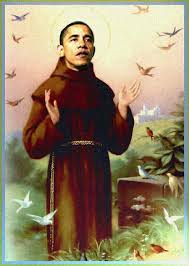
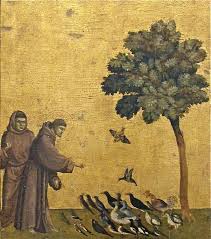
There is a long history of taking birds as signs. We can find such references throughout the Bible, Greek and Roman mythology, Homer, and in magic.   But what is more interesting than spotting a bird at certain events is the relationship of the Saint to the Bird.  The stories around Saint Francis of Asissi (c 1220) and his relationship to birds are well known around the world.   Animals are said to have no fear of him. They would visit him and dwell in his peaceful presence.   (And this, of course, hearkens to Isaiah 11:6, which talks of the wolf and the lamb and other animals lying down with each other – rather than fighting – in the messianic era.)


His “Sermon of the Birds” lauds the birds as blessed by God. He sees birds as model for humankind to envision itself and also a model for serving God through song and praise.

My little sisters, the birds, much bounden are ye unto God, your Creator, and always in every place ought ye to praise Him, for that He hath given you liberty to fly about everywhere, and hath also given you double and triple rainment; moreover He preserved your seed in the ark of Noah, that your race might not perish out of the world; still more are ye beholden to Him for the element of the air which He hath appointed for you; beyond all this, ye sow not, neither do you reap; and God feedeth you, and giveth you the streams and fountains for your drink; the mountains and valleys for your refuge and the high trees whereon to make your nests; and because ye know not how to spin or sow, God clotheth you, you and your children; wherefore your Creator loveth you much, seeing that He hath bestowed on you so many benefits; and therefore, my little sisters, beware of the sin of ingratitude, and study always to give praises unto God.

The image of the bird visiting Bernie on stage certainly draws on this lore and stokes the messianic coals. But we also find lore about man and animal in the Kabbalah, in Hasidic lore, and a book (which both address) called the “Chapter of Song.”   Although there are many disputes over the origins of the Chapter of Song, there is agreement on the fact that it was published in 1576, in Venice, as an illuminated manuscript. But before being published, it was mentioned in many different places in the 12th and in the 13th centuries.   It had great appeal to mystics and allusions to a book of songs to animals can be found in the Midrash and the Talmud. They accompany what is called (after the first chapter of Ezekiel) “merkavah (chariot) mysticism.” Ezekiel’s chariot includes different animals that, in some way, have symbolic relationships with divinity.  In addition, Isaiah also refers to angels as wild animals and suggests such relationships. These relationships may be downplayed by the Rabbis in the Talmud and in the medieval period, but they were of great interest to the Kabbalists.

Kabbalists like Rabbi Isaac Luria and Moses Cordovero discuss the book and suggest that there are correlations between animals and the higher spheres. The Baal Shem Tov and his grandson, Rabbi Nachman of Breslav, also discuss the relationship of man to animal and of the animal to God. Learning the language of birds and frogs – by way of listening closely to them – takes on a mystical meaning for them and even finds its way into several Hasidic meditations.

Zvi Mark – in his book on Rabbi Nachman, Mysticism and Madness – points out how there is a significant difference between the Kabbalists and the Hasidim regarding these songs. And this difference has to do with moving from the text (meditating on and singing the songs, which the Kabbalists do) to creating a relationship with animals (and ritualizing it).

The widespread custom of kabbalists and others of reading daily the text of the Chapter of Song, which opens with the description of the frog’s song and praises to God, is transformed into a custom of taking a daily walk alongside swamps and pools of water in an attempt to hear the song of the frogs. They (went)….in order to literally…hear the frogs croak in an attempt to ascertain from them how song and praise raise to God. (113)

But the fact of the matter is that animals are all over Hasidic lore and can be found in the Talmud and Midrash. Animals intervene in human affairs and are often thought to be messengers of God (like angels).   In Jewish mysticism they have symbolic meaning but in Hasidic stories actual animals are – from time to time – thought to be giving a unique message or a saving grace to this or that person.

In Yiddish literature and in the art of Marc Chagal, we see this Hasidic notion of a relationship between man and animals enlarged and secularized.   Shalom Aleichem’s Motl loves his calf while Chagal has countless paintings that pair humans with chickens, crows, and cats in a kind of mystical aura.

Given this, the idea that a bird or frog would have a mystical effect on an audience is not by any means so far fetched. And it is not simply a mystical idea that is owned by this or that religion or sect. To be sure, it is mainstream. Through animation, the idea that animals and humans are on the same level, can communicate, and can experience something almost or actually divine went mainstream. I’ll end with s clip of this kind of…animism. The animation – which takes animals as subjects – illustrates how Americans are enchanted by a secular kind of popular messianism.  It is communicated by or through human-like animated animal figures.   Through animation, the fine line between man and animal is effaced.  In the 1920s and 30s, it takes on an American kind of aura.  We’ve been “feeling the bird,” so to speak, for quite a while.