
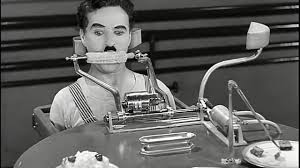
One of the greatest scenes in American film history is Charlie Chaplin’s film, Modern Times (1936).
Charlie Chaplin’s “Modern Times” (1936) is a satirical comedy that critiques the dehumanizing effects of industrialization. Chaplin’s iconic Tramp character struggles to survive in a mechanized world, facing assembly-line monotony, unemployment, and the economic hardship of the Great Depression.
The film masterfully blends slapstick humor with social commentary, highlighting the tension between humanity and the relentless pace of modern progress.
The Schlemiel figure, classically marked by his clumsy vulnerability, is reflected in Chaplin’s Tramp. In “Modern Times,” the Tramp’s struggle against the mechanized factory is a quintessential Schlemiel narrative: he’s overwhelmed by forces beyond his control—conveyor belts, gears, and rigid systems.
His humanity—like the Schlemiel’s—is preserved through humor and resilience, but he remains out of sync with the relentless logic of the machine, embodying a profound commentary on modern alienation.
In a Three Stooges scenario, machinery is often a direct source of chaos, with the Stooges creating slapstick mayhem as they bumble through mechanical tasks. The difference, however, is that the Stooges’ humor is more anarchic—machines become props for physical comedy. In “Modern Times,” Chaplin’s Schlemiel isn’t just clumsy; he’s a poignant reflection of the human being dwarfed by industrial systems. The Stooges lampoon incompetence; Chaplin’s Tramp critiques the system itself.
Phenomenologically, these interactions with machines reveal a tension between embodied human intentionality and the rigid, indifferent structures of technology.Chaplin’s Tramp and the Stooges both embody a human presence that doesn’t naturally sync with mechanical rhythms. The machine operates on fixed logic, while the human—finite, improvisational—finds friction there. The slapstick “errors” are, in a deeper sense, a manifestation of human intentionality colliding with a world of objects that do not reciprocate. The result is a kind of existential misfitting—where the Schlemiel (or Stooge) reveals the gap between human agency and the mechanized world.
Phenomenologically, when we witness these absurd human-machine interactions, we’re invited to reflect on the nature of freedom and constraint.
The machine represents a predetermined, rigid structure—a system that imposes order. The Stooge or Schlemiel, by failing within that system, reveals the contingency and non-necessity of these structures. While the characters seem trapped, the audience experiences a kind of liberation through laughter.
In other words, these comedic breakdowns highlight that technological systems are not absolute—they are contingent constructs. Thus, there’s a subtle agency in human error. By watching these characters fail, we’re reminded that we are not just cogs; there’s room to resist, redefine, or subvert the systems we encounter.
The humor is a phenomenological rupture that opens a space for reflection on freedom itself.
Ai and the Schlemiel
When we think of AI, the Schlemiel’s relationship is once again that of a human caught in a system of logic beyond their full comprehension. AI is precise, predictive, and dispassionately efficient. The Schlemiel, stumbling in interactions with AI, reveals that human life isn’t reducible to data.
Just as Chaplin’s Tramp is out of sync with industrial machines, today’s Schlemiel might find themselves bewildered by algorithmic decisions. But here, too, is a margin of freedom: the Schlemiel’s failures are reminders of human unpredictability, creativity, and ethical judgment—things AI cannot fully replicate.
By showing where we fail or resist AI’s logic, the Schlemiel highlights our capacity to redefine the rules, reminding us that even in a world of AI, human meaning—and freedom—emerges in the gaps.
Freedom emerges in the gaps, it’s in the moments where AI logic fails to account for human nuance that our agency appears. AI optimizes for patterns; the Schlemiel, by contrast, stumbles or defies pattern expectations.
In that gap—where the human does something unexpected, irrational, or imaginative—we assert what is uniquely ours.
These gaps are where human values, ethical choices, or creative impulses arise, often outside what AI anticipates. Thus, the Schlemiel’s “failure” signals that not everything about human existence is programmable or predictable. The gap is where we invent meaning.
Unpredictability in the Schlemiel is integral because the Schlemiel disrupts the expected order—both social and logical. In comedy, we anticipate patterns, but the Schlemiel’s missteps subvert them. Phenomenologically, this unmoors us from the ordinary flow of meaning, exposing the world’s openness. The Schlemiel’s unpredictable blunders reveal that the rigid systems—whether social norms, machines, or AI—are not all-encompassing. Instead, human fallibility opens up a space for novelty, improvisation, and reinterpretation.
Comedy, then, becomes an existential act: the Schlemiel reminds us that life’s trajectory isn’t locked. The viewer, sharing in that unexpected twist, gains a phenomenological insight: freedom lies in the fact that, at any moment, life can be otherwise—and it’s precisely in that “otherwise” that agency—and laughter—arise.
The Schlemiel, Cultural Intervention, and the Unpredictable
The Schlemiel, and the laughter he/she evokes, is crucial. In a society driven by efficiency, optimization, and systems—be it technology, bureaucracy, or social norms—there’s a risk of becoming rigid, unreflective, and deterministic. The Schlemiel’s comic misstep ruptures that rigidity. It reminds us that beneath systems lies the unpredictable: the human.
Without that reflection on the “otherwise”—the possibility that things could be different—we risk a kind of cultural stasis. The Schlemiel, in falling out of sync, opens up the space for creativity, questioning, and even societal change. Thus, the Schlemiel—and our laughter—is not trivial. It’s a cultural corrective, reminding us that there’s always another way—and that freedom, and even ethical responsibility, lies in seeing those possibilities.
The ethical dimension arises because the Schlemiel’s disruption forces us to reconsider the rigid structures we take for granted—be they technological, social, or moral.
The Schlemiel’s “failure” reveals that human life isn’t reducible to rules or optimization. Ethically, recognizing these gaps—moments where the Schlemiel shows us that systems can be questioned—gives us a responsibility to rethink how we treat others, how we design systems, and how we allow for human complexity. The Schlemiel reminds us that without seeing these possibilities—without laughing at the rigidity—we risk becoming ethically complacent. Thus, the Schlemiel’s existence prompts us to remain open, adaptable, and attuned to the ethical demand to question—and humanize—the systems we live in.
The Schlemiel, through their clumsy misalignment with what’s “supposed to happen,” provokes laughter that’s more than amusement—it’s a moment of rupture. When we laugh, we’re acknowledging the rigidity of our norms, and that laugh momentarily frees us from them. The Schlemiel elicits this act of recognition: things don’t have to be as rigid as we’ve assumed. In that sense, the Schlemiel’s “failure” is an invitation: our laughter signals that we recognize the cracks in the system. From there, we can rethink and reshape—an ethical and cultural act in itself.
Consider Chaplin’s “The Great Dictator.” On the surface, it’s comedy—Chaplin’s Schlemiel-like character fumbles in a parody of authoritarianism. But that laughter unmasked the rigid, dangerous logic of fascism at a crucial historical moment. The film’s laughter wasn’t trivial—it ruptured the aura of inevitability around tyrannical power, allowing viewers to imagine otherwise. More broadly, films like “Dr. Strangelove” satirized Cold War rationality, exposing absurd gaps in nuclear logic. In each case, the Schlemiel figure—through laughter—invites society to confront its rigidities, creating a cultural moment where reflection—and action—become possible.
Chaplin’s “Modern Times” or “The Great Dictator” didn’t just entertain—they showed audiences the absurdity of being reduced to cogs in a machine or of unchecked authoritarianism. The laughter they evoked was a cultural reset, nudging society to see that things could be otherwise. Similarly, the Three Stooges’ chaotic slapstick subverted authority and structure, highlighting that everyday life wasn’t so rigid after all. These works, by puncturing cultural rigidity, helped shift collective imagination toward possibility—toward questioning, adapting, and envisioning a more open future.
In 2026, we find ourselves once again at a moment where the Schlemiel’s legacy offers us a cultural intervention. Just as Chaplin exposed the dehumanizing machinery of industrialization, and the Stooges mocked authority with chaos, today’s Schlemiel confronts an era of algorithms, automation, and AI determinism. The unpredictable misstep reminds us that, beyond these systems, human freedom and ethical possibility persist. Just as past comedies helped society reflect and adapt, we now have the same responsibility: to laugh at our rigidities, to see the gaps in our systems, and to create a future where human agency—in all its unpredictable, Schlemiel-like richness—remains at the center of what is possible.
Think about Woody Allen, the modern Schlemiel par excellence—neurotic, fumbling through New York, always tripping over relationships, existential questions, and even lobsters. He’s the guy who shows us that life is messy and that’s okay. Just like Chaplin’s Tramp or the Stooges with their wrenches, Allen’s self-deprecating humor reminds us that we don’t need to have it all together. So, whether we’re dodging AI or just trying to get through another awkward dinner date, the Schlemiel’s still here to say, “Relax! Laugh a little—you’ll see life isn’t as rigid as you think!”
Mistakes happen, life is unpredictable. The schlemiel is always in wonder about how unpredictable it is. If he only saw that banana…
 Schlemiel Theory